
Section 401 of the federal Clean Water Act requires state certification for any permit or license issued by a federal agency for an activity that may result in a discharge into the waters of the United States (WOTUS). Water quality certifications ensure projects comply with state water quality standards and any other water quality requirements under state law.
The US Environmental Protection Agency (EPA) published the Final 2023 Clean Water Act Section 401 Water Quality Certification Improvement Rule (2023 Rule) in the Federal Register on September 14, 2023 (40 CFR 121). It took effect on November 27, 2023.
Passed by Congress in 1972, the federal Clean Water Act grants states and tribal governments the authority to review and approve, condition or deny proposed projects, actions and activities directly affecting waters of the United States. In Idaho, DEQ is responsible for issuing § 401 water quality certifications required for federally licensed projects located on nontribal lands. Any conditions that DEQ requires in a § 401 Water Quality Certification will be included as conditions of the federal license or permit.
To request a § 401 Water Quality Certification:
- Submit a Prefiling Meeting Request (details below)
- At least 30 days after submitting a Prefiling Meeting Request, or unless otherwise indicated by DEQ, submit a Water Quality Certification Request (details below)
Prefiling Meeting Request
The 2023 Rule requires all project applicants to submit a prefiling meeting request to DEQ at least 30 days before submitting a § 401 Water Quality Certification Request. DEQ may waive or shorten the prefiling meeting period and has prepared a Prefiling Meeting Request form for project applicants to use when requesting a prefiling meeting. Requests will be reviewed on a case-by-case basis and regional DEQ staff will contact you to schedule a prefiling meeting if one is necessary.
Recommended project information and supporting documentation may include the following:
- A copy of the Joint Application for Permits
- Identification of the Nationwide Permit
- Project description, location, map
- Anticipated construction timeline
- Receiving water body information
- Potential water quality related impacts
- Readily available water quality related materials
This list is not inclusive; any plan or documentation that supports the goal of protecting water quality is acceptable.
Prompt notification will be provided if the prefiling meeting request is not submitted in accordance with the 2023 Rule or if additional information is needed.
Submission Procedures
Submit requests, project information, supporting documentation, and questions electronically to certificationrequests@deq.idaho.gov.
An email receipt will be provided for your records when your request for a prefiling meeting is received. If a receipt is not received in a timely manner, call (208) 373-0187.
If you are not contacted by the regional office for a prefiling meeting and at least 30 days have passed, you may submit a § 401 Water Quality Certification Request to DEQ if it is required for your project.
If a prefiling meeting is scheduled, the meeting may be held in person or remotely. Be prepared to discuss the project and potential water quality related impacts.
Water Quality Certification Request
A certification request is a signed and dated, written document that satisfies the minimum requirements of 40 CFR 121.5(a) and (c). Once a § 401 certification is requested, DEQ must act within the reasonable period of time, which cannot exceed 1 year.
Most certifications are issued for US Army Corps of Engineers (Corps) permitted activities. The reasonable period of time is typically 60 days and will be jointly determined on a case-by-case basis by DEQ and the federal agency.
When a certification is required for a Federal Energy Regulatory Commission (FERC) license or other federal action, the reasonable period of time begins when the certification request is received and will not exceed 1 year.
To start the statutory clock, the following components must be provided in the Water Quality Certification Request:
- Project information including name, purpose, proposed activity, and anticipated construction timeline.
- Identification of the Corps’ confirmed Nationwide Permit number.
- A map or diagram of the proposed activity site.
- The specific location(s) and description of any potential discharge and likely pollutants that may result from the proposed activity.
- Description of methods and best management practices to manage all discharge(s) and likely pollutants that may result from the proposed project.
- Identification of the date that a prefiling meeting request was submitted and the date of the prefiling meeting, if applicable.
- Supporting documentation and readily available water quality related materials such as:
- Copy of the Joint Application for Permits (if not previously provided)
- Erosion and Sediment Control Plan
- Storm Water Pollution Prevention Plan
- Water Quality Monitoring, Control, and Protection Plan
- Wetland Delineation Report and Ratings
- Soils Testing and Characterization Reports
- Suitability determination for dredging projects within water disposal
- Dredging and Excavation Plans
- Flow Diversion, Cofferdam and Dewatering System Plan
- Mitigation Plan
- Riparian Revegetation, Restoration, and Management Plan
- Aquatic Invasive Species Management Plan
- Spill Prevention Control and Countermeasures Plan
- Summary of wastewater servicing for marina operations
- NEPA analysis
This list is not inclusive; any plan or documentation that supports the goal of protecting water quality is acceptable.
Prompt notification will be provided if the certification request is not submitted in accordance with the 2023 Rule or if additional information is needed.
Submission Procedures
Submit certification requests, supporting documentation, and readily available water quality materials electronically to certificationrequests@deq.idaho.gov. An email receipt will be provided for your records when the certification request is received. If a receipt is not received in a timely manner, call (208) 373-0187.
Water Quality Certification Timeline
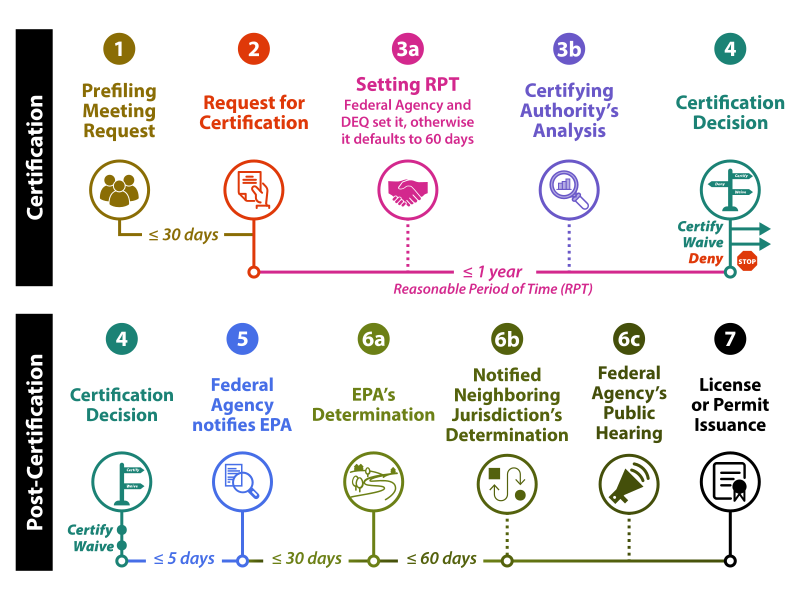
DEQ’s general certification timeline overview is in the graphic below.
The prefiling meeting period at Step 1 may be shortened or waived at DEQ’s discretion. At Step 3a, DEQ and the Corps agree that the default RPT is 60 days. For FERC licensing, the RPT is 1 year from the certification request receipt date. For more information, visit EPA’s 401 web page.
Public Involvement
Comment opportunities for draft § 401 water quality certifications typically run between 21 and 45 days. An email subscription is encouraged to receive updates and notices about comment opportunities, and we invite you to provide input on these projects. To receive email updates, provide your email address in the prompt box located at the bottom of the public comment opportunities web page.
Because FERC does not provide notice to the public, DEQ will issue its own public notices for certification, including the following:
- 30-day notice for certification request receipt indicating the anticipated timeline for DEQ to issue a draft certification
- 45-day notice for draft certification public comment review period, including the right to request a hearing or meeting to submit oral comments within 15 days of posting
Comments received on draft certifications will be reviewed before final issuance. Visit our web page to find a DEQ-issued permit or water quality certification.
The applicant or “other aggrieved person” may appeal DEQ’s final decision regarding a 401 certification under the Idaho Environmental Protection and Health Act (Idaho Code § 39- 107(5)) and the Idaho Administrative Procedure Act. Such an appeal is a prerequisite to any district court action. It must be initiated by filing a petition for a contested case by the Rules of Administrative Procedure before the Board of Environmental Quality (IDAPA 58.01.23) within 35 days of the date of DEQ’s decision regarding the 401 certification.
Dredge and Fill 401 Certifications
Under Clean Water Act (CWA) § 401 (33 U.S.C. § 1341), DEQ reviews and certifies that a federally permitted or licensed project complies with state water quality standards when there is a discharge to waters of the United States. Under CWA § 404, the US Army Corps of Engineers (Corps) authorizes discharges of dredged or fill material within waters of the United States associated with regulated activities. Corps-issued permits include Nationwide Permits (NWPs), which authorize activities that have minimal individual and cumulative effects on the aquatic environment. In Idaho, the Corps’ Walla Walla District administers the NWP program.
On January 8, 2026, the Corps reissued 56 NWPs and issued one new NWP, along with general conditions, as published in the Federal Register (91 FR 768). These NWPs became effective on March 15, 2026.
On December 16, 2025, DEQ issued its Final Section 401 Water Quality Certification (WQC) for activities in Idaho that qualify for the Corps’ 2026 NWPs. Projects are covered under this general certification or require an individual WQC. Table 1 provides a summary of DEQ’s certification decisions to help determine which is needed. If DEQ denies coverage or imposes conditions that cannot be met under the general certification, project proponents must apply for an individual § 401 WQC.
Hydropower Plant Licensing
The Federal Energy Regulatory Commission (FERC) is responsible for issuing licenses for the construction of new hydropower projects, relicensing existing projects, and overseeing ongoing project operations, including dam safety inspections and environmental monitoring.
Before FERC may license or relicense non-federal hydroelectric dams, a state certification is required. A company that has applied for a FERC license must also request a § 401 Water Quality Certification. DEQ must grant or deny certification within 1 year of receipt of the request. If the state has not granted or denied the certification within 1 year of the request, certification is considered waived.
Idaho Pollutant Discharge Elimination System
State governments authorize the Idaho Pollutant Discharge Elimination System (IPDES) permit program by the Environmental Protection Agency (EPA) to perform many permitting, administrative, and enforcement aspects. The Clean Water Act prohibits anybody from discharging “pollutants” through a “point source” into a “water of the United States” unless they have an IPDES permit. The permit will contain limits on what you can discharge, monitoring and reporting requirements, and other provisions to ensure that the discharge does not hurt water quality or people’s health.
An IPDES permit authorizes a permittee to discharge pollutants from point sources into waters of the United States in Idaho, except on tribal land.
Please visit our Permit Options web page for additional wastewater IPDES permit information.
Storm Water Regulation
DEQ requires permit coverage of storm water discharges according to applicable federal requirements. Storm water permits are typically general permits and cover storm water runoff from construction projects, industrial facilities, and municipal separate storm sewer systems (MS4). DEQ will apply regulatory criteria in IDAPA 58.01.25.130 to determine which permit type to issue. Three categories of storm water discharges are covered in the IPDES Program: construction, industrial, and municipal activities.
Discharges from construction activities that disturb one or more acres, including discharges from smaller sites that are part of a common plan of development or sale, must obtain permit coverage. Construction storm water permits include requirements for erosion and sediment control, pollution prevention, and site stabilization from the Construction and Development Effluent Guidelines and Standards (40 CFR 450).
Please visit our Stormwater web page for additional permit coverage information.
Staff Contact
401 Certification Lead